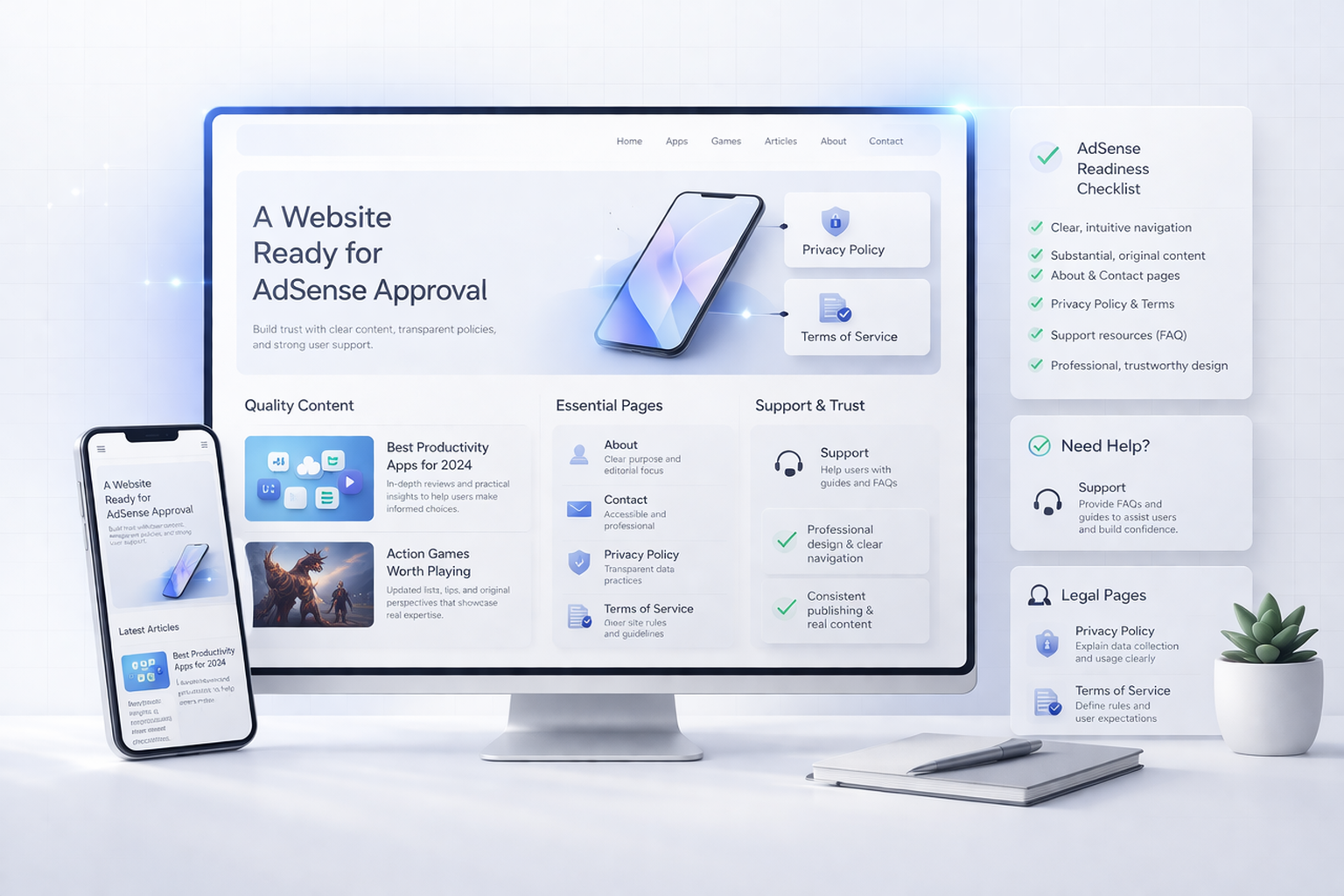
A site that is easier to approve in AdSense looks useful to readers before it looks monetized. That is especially important for apps and games websites, where it is easy to end up with a thin portfolio made of cards, store links, and short blurbs.When these sites get rejected, the problem is rarely one missing tag. It is usually the full picture: too little helpful content, too many short listing pages, thin public trust pages, and no clear editorial angle.## What should be obvious at first glance - simple navigation between home, articles, about, and contact - public legal pages that are easy to find - a visible support email and a credible public identity - multiple URLs with original text, not only listings## What to avoid - a homepage that looks only like a download hub - pages with two or three sentences and nothing useful beyond that - duplicated text between product pages, articles, and legal pages - sections that exist in navigation but remain almost empty## Minimum technical checklist - updated sitemap and robots - correctly published ads.txt or app-ads.txt - coherent canonical and meta descriptions - important pages accessible without obvious errors## Minimum editorial checklist - a few articles or guides written for humans - richer descriptions on important URLs - internal links between articles and trust pages - steady updates instead of a single burst of contentAdSense does not become easier because a site looks polished. It becomes easier because the site is understandable. If structure and content clearly explain who publishes it, what gets covered, and why the pages deserve visits, approval becomes much more realistic.
Editorial
29 March 2026
anonym93 Studio
adsense
seo
content
How to prepare a site for Google AdSense approval
A practical checklist for content depth, legal pages, navigation clarity, and trust signals.
Continue reading
More articles from the archive
Editorial
What valuable content means for an apps and games website
Why listing pages are not enough and how to turn a portfolio into a genuinely useful editorial hub.
29 March 2026
Editorial
How to Migrate from React SPA to Blade + Alpine.js: Real Case Study on anonym93.dev
I migrated anonym93.dev from a React SPA with 500KB JavaScript to Blade + Alpine.js with only 68KB CSS and zero application JS. Here's what I learned, what worked, and the Core Web Vitals scores before and after.
18 April 2026
Editorial
SSR vs SPA vs SSG: Which to Choose for a Business Website
Practical comparison of the three rendering architectures — Server-Side Rendering, Single-Page Application, and Static Site Generation. Real Core Web Vitals scores, trade-offs, and concrete recommendations for business sites.
18 April 2026